
How to Write a CV That Gets You Shortlisted
Grace, a Nairobi-based operations manager with nine years of experience, came to us with a CV that read like a job description duties, duties, duties, no results. Within three weeks of rewriting it around impact, she had two interview invitations for regional roles she had been rejected for twice before.
Here’s what changed: nothing about her actual career. Same employers, same years, same responsibilities. What changed was the story the CV told about what she did with all of it. And that distinction matters more than most job seekers realise, especially once you understand what actually happens to a CV after you hit submit.
The truth about what’s screening your CV
You’ve probably heard the claim that 75% of CVs are rejected by an applicant tracking system (ATS) before a human ever sees them. It’s one of the most repeated statistics in job-search content and a 2025 study by Enhancv, which interviewed 25 recruiters across industries and company sizes, found it doesn’t hold up. Ninety-two percent of the recruiters said their ATS does not auto-reject candidates based on CV content at all. What actually filters people out are knockout questions hard requirements like minimum experience, qualifications, or work authorization set by the employer, not a silent algorithm judging your formatting.
This matters because it changes where your energy should go. Chasing an imaginary algorithm with keyword-stuffing tricks wastes time. What’s real, and well documented, is this: recruiters spend an average of 7 to 11 seconds on their first scan of a CV, according to eye-tracking research from TheLadders and more recent screening-behaviour data from InterviewPal. Only about 14% of recruiters ever spend more than a minute on one CV.
PRO TIP: Put your single strongest, most quantifiable achievement in the top third of page one — ideally in your profile summary or first bullet. If it’s not visible in the first 10 seconds, assume it won’t be read at all.
Lead with impact, not duties only
Replace “Responsible for managing a team of 12” with “Led a team of 12 to reduce operational costs by 18% in one year.” Every bullet on a management-level CV should answer one question: so what happened because you were there? A duty tells a recruiter what your job was. A result tells them what you’re capable of producing again, for them.
This is the single biggest shift we make with clients moving from mid-level to senior roles. Duties are interchangeable across candidates with the same job title. Results are yours alone, and they’re what separates a CV that reads as “ready for more” from one that reads as “currently doing fine where they are.”
Quantify everything you can even careful estimates
Numbers give a recruiter something concrete to compare across dozens of similar candidates. “Managed regional client relationships” says very little. “Managed relationships across a $2.5M regional client portfolio spanning four countries” tells a completely different, much more senior story using the same underlying job.
If you don’t have exact figures, a defensible estimate (“approximately,” “over,” “more than”) is far better than no number at all. Budget size, team size, percentage improvements, client counts, project timelines all of it gives shape to decisions a recruiter otherwise has to guess at.
Tailor your competencies to the seniority you’re targeting, not the one you hold
List the skills the next role needs, not just the ones your current title requires. If you’re applying for a director-level role while holding a manager title, your competencies section should already speak the language of the role above you: strategic planning, P&L ownership, cross-functional leadership, stakeholder management at board level whatever is genuinely true of the scope you’ve been operating in, even informally.
This is also where formatting quietly matters. Research from EDLIGO’s 2025 analysis of 1,000 rejected CVs across Workday, Taleo, and Greenhouse found single-column layouts parse with 93% accuracy versus 86% for two-column designs, and plain DOCX files fail to parse correctly only 4% of the time compared to 18% for PDFs submitted through some systems. None of this replaces strong content but a beautifully written CV that parses badly is still a CV nobody reads properly.
Summarise anything older than 15 years unless it’s directly relevant
Senior recruiters are reading for trajectory, not a full biography. A CV that stretches back 25 years with equal weight given to every role signals uncertainty about what actually matters. A tighter CV, weighted heavily toward your last 10 to 15 years, signals confidence: you know exactly which parts of your career make the case for this next move.
THE MISTAKE WE SEE MOST OFTEN: Clients frequently under-sell recent achievements because they assume the reader will “just know” what a job title implies. They won’t. A recruiter comparing 250+ applications for a single posting the average for a corporate role, according to Glassdoor data has no time to infer your impact. State it plainly, or it won’t be counted at all.
A CV for a management role is a different document with a different job: proving, in the space of a 10-second skim, that you can be trusted with bigger decisions. Grace’s rewrite didn’t add new experience. It simply stopped hiding the experience she already had.
Ready to take the next step in your career?
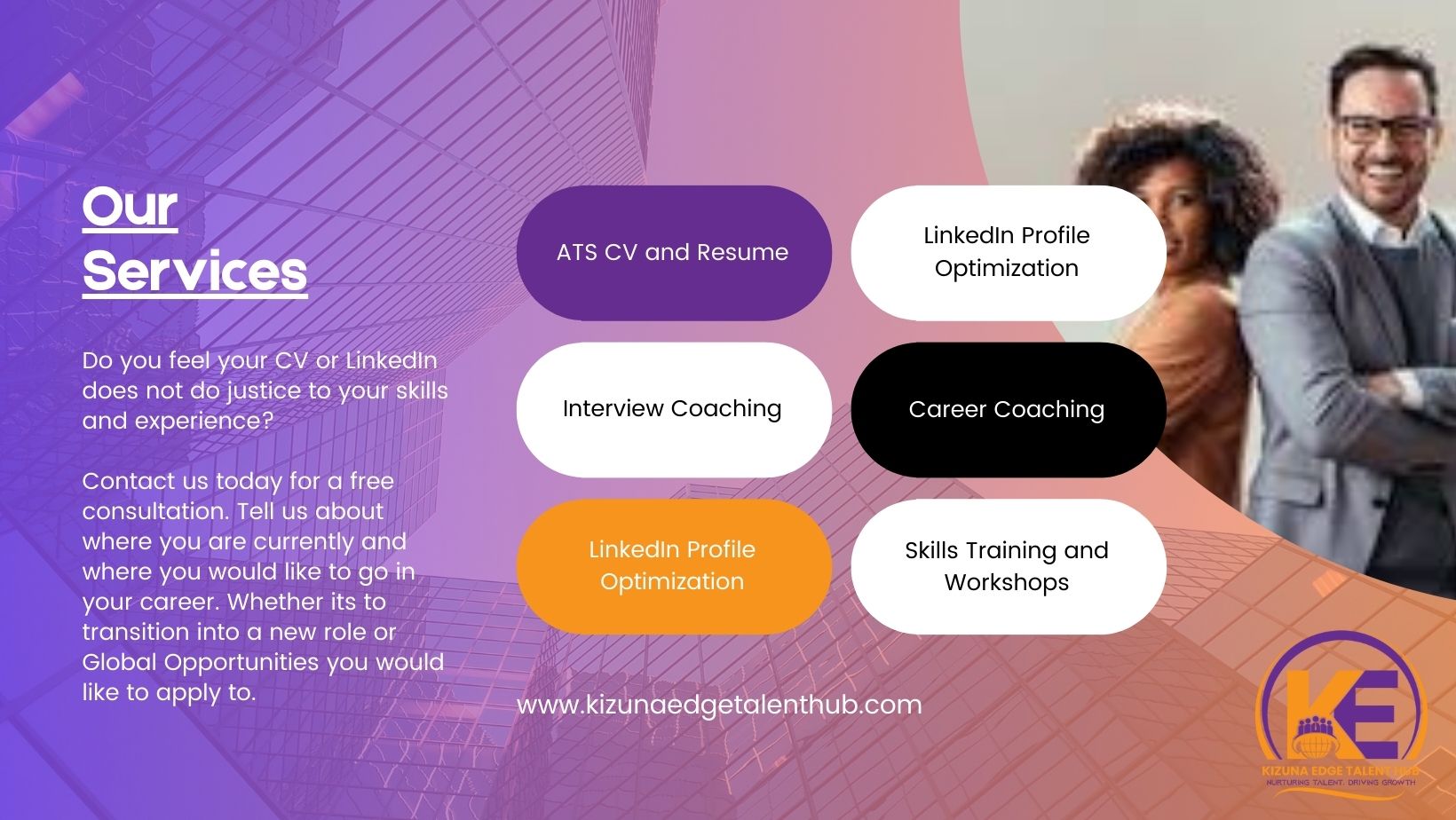
KETH Africa (Kizuna Edge Talent Hub) helps African professionals build CVs, LinkedIn profiles, and career strategies that open doors to executive and global opportunities.
Email: kethafrica@gmail.com | info@kizunaedgetalenthub.com
WhatsApp/Call: 0742118284
Join our career community: https://forms.gle/pJZXzQznoxrDPGam9
#jobsinafrica #cvwritingservicesinkenya #linkedinrevampservicesinkenya
Discover more from Kizuna Edge Talent Hub
Subscribe to get the latest posts sent to your email.